
Hallway lights that stay on all night, and a lobby nobody’s watching.
Common areas are the parts of a building everyone uses and no one owns. Hallways, lobbies, parkades, laundry rooms, fitness rooms and party rooms all run on the same unspoken rule: someone else will deal with it.
So the lights stay on in an empty corridor at 3 a.m. The amenity room heat runs all weekend for nobody. The lobby camera records, but nobody checks it until something goes wrong.
Common area automation fixes this by making shared spaces respond to how they’re actually used. Lights come on when people are there and dim when they aren’t. Heating follows a schedule. Doors, cameras and sensors report back, so you know what’s happening without walking every floor.
There’s a catch, though, and it’s the reason many automated buildings end up with residents propping doors open and taping over sensors. More on that below.
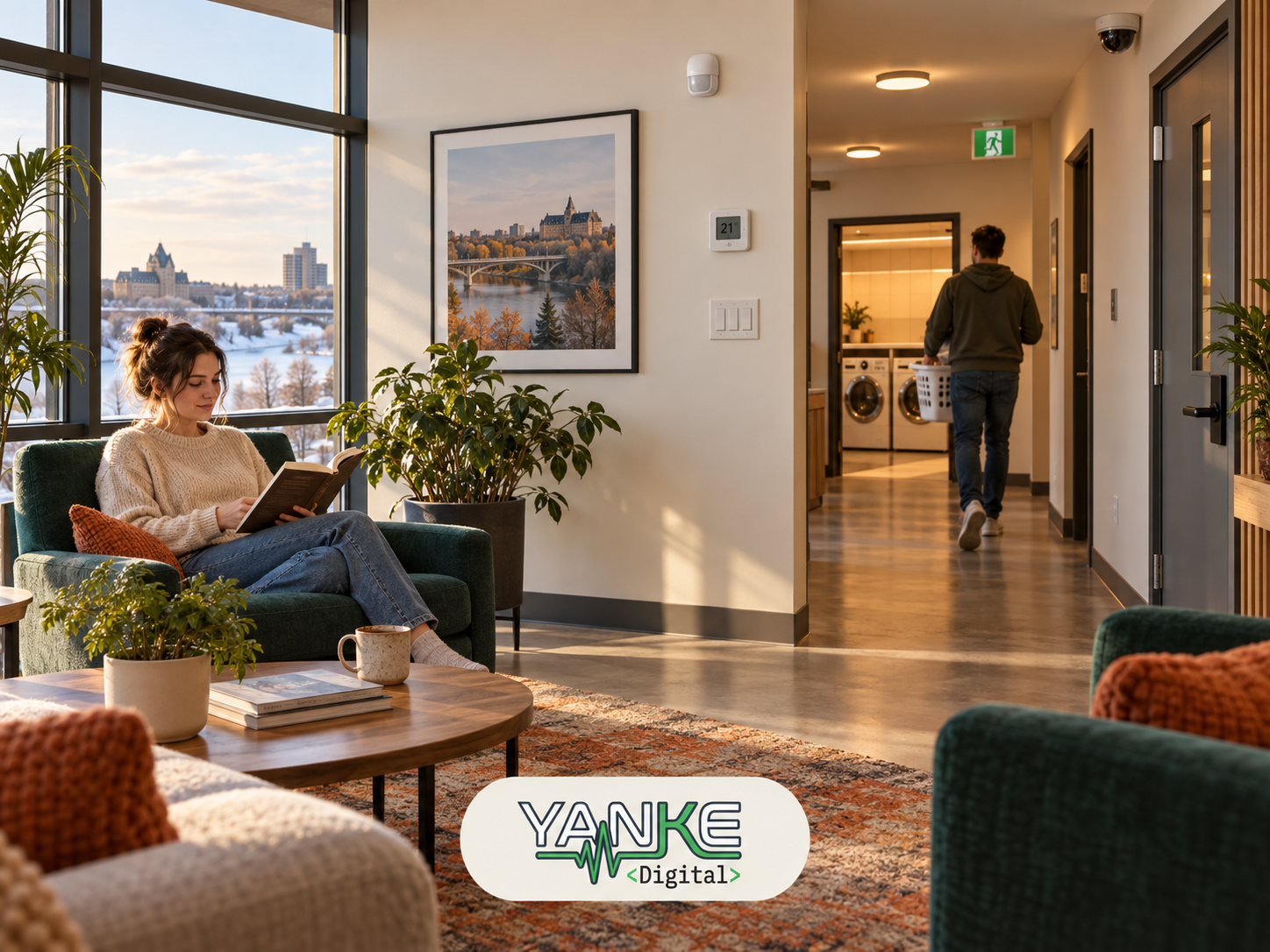
Lighting: the easiest win
Lighting is usually where buildings start, because the waste is easy to see.
- Occupancy and vacancy sensors in hallways, stairwells, washrooms and storage rooms turn lights on when someone enters and off after a set time.
- Dimming instead of off. In corridors and parkades, many buildings prefer lights that drop to a low level rather than going dark, so nobody steps into a black hallway.
- Schedules for lobbies and exteriors. Entrances and walkways can follow sunset and sunrise rather than a timer that drifts with the seasons.
- Scenes for amenity rooms. A party room can have a "event" setting and a "cleaning" setting, controlled from a simple wall panel.
Remember that code-required emergency and exit lighting is a separate system with its own rules. Automation works on the everyday lighting, not those circuits. Any new wiring or fixture work should be done by a licensed electrician.
Climate: comfort without the waste
Shared spaces are often heated or cooled as if they’re always full. Smart thermostats and environmental sensors let you:
- Set schedules for amenity rooms, gyms and offices based on booking times or opening hours
- Keep lobbies comfortable without overheating them on sunny afternoons
- Monitor temperature in mechanical, electrical and storage rooms, with alerts if something drifts out of range
- Track humidity in pool areas, parkades or below-grade spaces where moisture causes trouble
In a Saskatchewan winter, a temperature alert from an unheated stairwell or a mechanical room can be the early warning you need before a pipe freezes.
Security: seeing what matters
A camera in the lobby is only useful if it’s pointed at the right thing and you can find the footage later. For common areas, the priorities usually are:
- Main entrances, intercom panels and secondary doors
- Parkade entries and exits
- Mail rooms and parcel areas
- Garbage and recycling rooms
Pair cameras with door sensors that alert you when a secondary door has been propped open too long, and access control that logs who used which fob, and the lobby nobody’s watching becomes a lobby that tells you when something’s off. Privacy expectations for cameras in residential buildings vary, so confirm what’s appropriate for your property.
Leak detection in shared spaces
Laundry rooms, mechanical rooms and the space around water heaters are prime spots for leaks that go unnoticed. Water sensors can send an alert the moment moisture appears, and in some cases trigger an automatic shut-off valve depending on the plumbing.
A common area audit you can do this week
Walk the building at night and at mid-day, and note:
- Which lights are on in empty spaces?
- Which rooms are heated or cooled when no one’s using them?
- Which doors get propped open, and how would you know?
- Where could water collect without anyone seeing it?
- If something happened in the parkade last night, could you find the footage in a few minutes?
- Which complaints come up most from residents?
The answers tell you where to start.
The part that trips buildings up
Here’s the catch we promised: automation that ignores how people actually use a space gets defeated.
A hallway light on a 30-second timer that clicks off while a resident is fumbling with groceries. A laundry room that goes dark mid-load because the sensor can’t see past the dryers. A gym thermostat locked so tight nobody can warm it up for a 6 a.m. workout. Residents respond the way people always do: tape, door wedges and calls to you.
The fix is design, not more technology. Put sensors where they can see the whole space. Choose timeouts that suit the room. Use dimming instead of darkness where it matters. Give residents a sensible override. Then adjust after a few weeks of real use. Good automation is the kind nobody notices.
Where Yanke Digital comes in
We design, install and support lighting controls, climate and environmental sensors, security cameras, access control and water detection for condos and apartment buildings in Saskatoon and across Saskatchewan.
Our process starts with what’s already there. We walk your common areas, look at existing equipment and wiring, and listen to the frustrations of staff and residents, then work out what can stay. We put equipment, compatibility, installation and pricing on the table together, so you can choose the essentials first. Lighting in one parkade or sensors in one laundry room is a reasonable first step.
We configure and test everything, fine-tune it once people start using the space, and walk your team through the controls. Ongoing support is there if you want it.
Let’s look at your shared spaces
Call 1-888-698-8001 to talk it through, or start mapping out your priorities with the free project planner. You don’t need to give contact details to use it.
See more about our work with multi-unit buildings on our multi-dwelling page.