
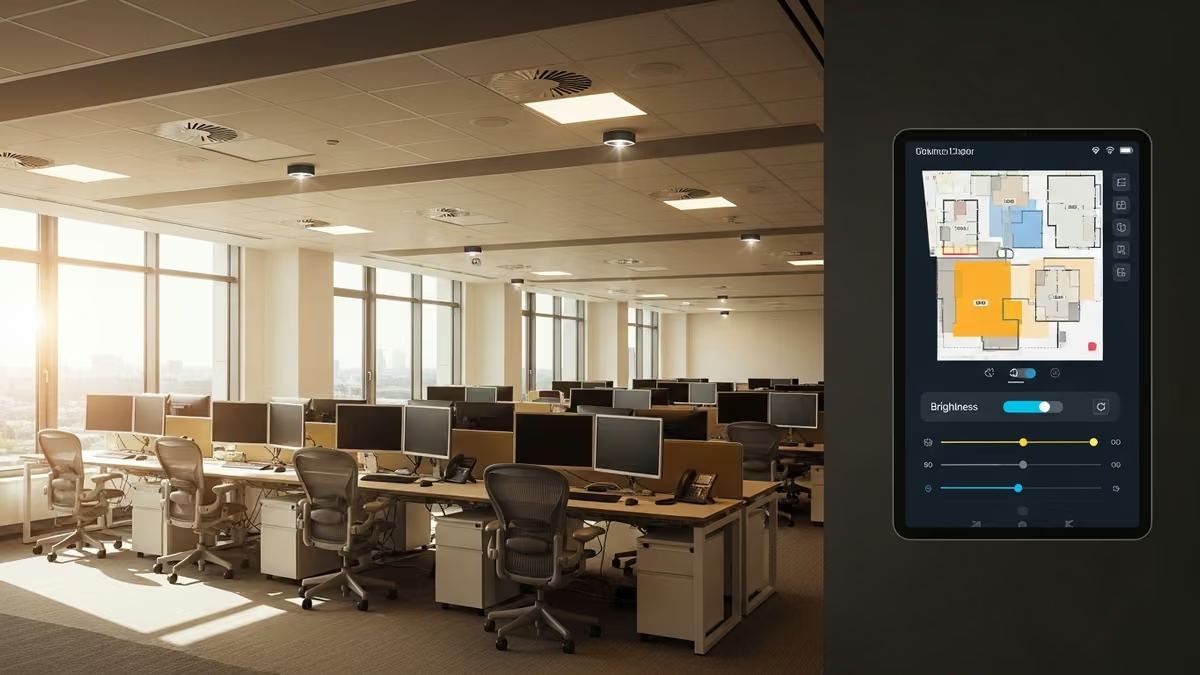
Commercial lighting automation is transforming how businesses manage energy consumption, workplace productivity, and regulatory compliance. Modern lighting control systems go far beyond simple on-off switches—they intelligently adapt to occupancy, daylight availability, and circadian rhythms, delivering measurable returns on investment while creating healthier, more efficient workspaces. For facility managers and business owners in Saskatchewan and beyond, understanding the strategic value of automated lighting is essential to staying competitive and sustainable.
What Is Commercial Lighting Automation?
Commercial lighting automation uses sensors, controls, and intelligent software to manage lights based on real-time conditions rather than manual operation. These systems integrate occupancy sensors, daylight harvesting technology, scheduling logic, and dimming capabilities into a unified ecosystem that optimizes light output, energy use, and user comfort simultaneously.
Unlike traditional fixed lighting, automated systems respond dynamically to:
- Occupancy and vacancy detection
- Natural daylight levels
- Time of day and seasonal changes
- User preferences and task requirements
- Energy demand and utility rates
The result is a lighting environment that works harder for your business—reducing waste, supporting employee wellbeing, and ensuring compliance with modern energy codes.
How Commercial Lighting Automation Drives Productivity
Lighting has a profound impact on employee performance, mood, and health. Commercial lighting automation productivity gains are well-documented in workplace research, and the connection is straightforward: the right light at the right time enhances focus, reduces fatigue, and supports natural circadian rhythms.
Circadian Rhythm Alignment
Advanced automated lighting systems can adjust color temperature and intensity throughout the day to mimic natural light cycles. Cooler, brighter light in the morning promotes alertness; warmer tones in the afternoon support sustained focus; dimmer, warmer light toward evening prepares the body for rest. This circadian-aligned approach reduces eye strain, improves sleep quality, and boosts daytime alertness—all of which translate to higher productivity and fewer sick days.
Task-Specific Lighting Control
Different work zones have different lighting needs. Open offices, conference rooms, detail-work areas, and break rooms all benefit from tailored illumination. Commercial lighting automation allows you to set optimal light levels for each space and task, reducing eye fatigue and enabling employees to work more efficiently without manual adjustments.
Reduced Glare and Flicker
Quality automated lighting systems eliminate the flicker and inconsistent brightness that plague older fluorescent fixtures. Smooth dimming, flicker-free LED technology, and responsive controls create a more comfortable visual environment that supports concentration and reduces headaches.
Energy Savings Through Intelligent Control
Lighting typically accounts for 20–30% of commercial building energy consumption. Commercial lighting automation energy savings are among the fastest ROI improvements available to facility managers. Here’s how:
Occupancy-Based Lighting Control
Motion and occupancy sensors automatically turn lights off in unoccupied spaces and dim or adjust them when people return. In conference rooms, restrooms, storage areas, and low-traffic zones, this alone can cut lighting energy use by 20–40%. Vacancy sensing ensures lights don’t stay on unnecessarily, while occupancy-based lighting control adapts to actual usage patterns rather than fixed schedules.
Daylight Harvesting
Photosensors measure natural daylight and automatically reduce artificial lighting when sufficient daylight is available. Perimeter offices and spaces with windows can realize 30–50% energy savings in daylit areas. The system continuously adjusts to cloud cover, time of year, and sun angle, maintaining consistent illumination while minimizing artificial light use.
Dimming and Load Shedding
Rather than on-off control, modern systems use proportional dimming to deliver exactly the light needed. A space might operate at 60% brightness during low-activity periods and ramp to 100% during peak hours. During peak energy demand periods, the system can automatically reduce non-critical lighting to help manage utility costs and demand charges.
Scheduling and Time-Based Control
Automated scheduling turns lights off during nights, weekends, and holidays when the building is unoccupied. Unlike manual control, scheduling is consistent and requires no human intervention. You can set different schedules for different zones—ensuring security lighting remains active while reducing energy waste in unoccupied areas.
Meeting Energy Code Compliance Requirements
Building codes and energy standards are tightening globally. Energy code compliance lighting requirements now mandate specific controls in new construction and major renovations. Commercial lighting automation helps you meet and exceed these standards without costly retrofits or operational compromises.
ASHRAE 90.1 and Local Building Codes
Standards like ASHRAE 90.1 (and equivalent provincial codes in Canada) require occupancy sensors in certain spaces, daylight harvesting in daylit zones, and automatic shutoff controls. Automated lighting systems are purpose-built to meet these requirements, simplifying compliance documentation and inspection processes.
Energy Performance Tracking
Modern commercial lighting automation systems provide detailed energy reporting and analytics. You can track consumption by zone, time period, and fixture type—identifying optimization opportunities and demonstrating compliance to auditors and regulators. This data transparency is increasingly important for sustainability certifications (LEED, BREEAM) and corporate ESG reporting.
Key Technologies in Modern Lighting Automation
Occupancy and Motion Sensors
Passive infrared (PIR) and microwave sensors detect movement and presence. Advanced sensors can distinguish between occupied and vacant states, reducing false triggers and unnecessary lighting adjustments. Some systems use multiple sensor types for greater accuracy in complex spaces.
Daylight Sensors (Photosensors)
Photosensors measure illuminance levels and trigger proportional dimming to maintain target brightness while minimizing artificial light use. Placement is critical—sensors should be positioned to measure light at the work plane, not directly in sunlight.
Wireless and Networked Controls
Modern systems use wireless protocols (Zigbee, Z-Wave, proprietary mesh networks) or hardwired control networks to communicate between sensors, controllers, and fixtures. Networked systems allow centralized management, remote adjustments, and integration with building management systems (BMS) and other smart building technologies.
LED Fixtures and Dimming-Compatible Ballasts
Automated lighting requires fixtures and ballasts that support dimming and rapid on-off cycling. LED technology is ideal—it’s inherently dimmable, long-lived, and energy-efficient. Older fluorescent or incandescent fixtures may not be compatible with advanced control strategies.
Central Control Platforms and Software
A unified software platform allows facility managers to program schedules, set occupancy thresholds, adjust dimming curves, and monitor system performance from a single dashboard. Integration with building automation systems enables lighting to respond to other building parameters (HVAC, security, occupancy data) for holistic optimization.
Practical Implementation: Design & Integration
Successful commercial lighting automation requires thoughtful design and expert integration. A one-size-fits-all approach rarely delivers optimal results. Here’s what a comprehensive implementation looks like:
1. Space Assessment and Zoning
Analyze your building’s layout, occupancy patterns, natural light availability, and task requirements. Group spaces into control zones based on similar characteristics—perimeter offices with windows, open office areas, conference rooms, corridors, and support spaces may each need different strategies.
2. Sensor Placement and Calibration
Proper sensor placement is critical. Occupancy sensors should be positioned to detect movement in the intended zone without false triggers from adjacent areas. Daylight sensors must be placed at the work plane and shielded from direct sunlight to provide accurate readings.
3. Control Logic and Scheduling
Define the control rules: occupancy thresholds, daylight dimming curves, time-based schedules, and manual override options. Different spaces need different logic—a conference room might use occupancy-only control, while a perimeter office combines occupancy with daylight harvesting.
4. User Training and Commissioning
Proper commissioning ensures the system performs as designed. Test all sensors, verify control logic, and train facility staff and building occupants on how to use the system. User education reduces frustration and maximizes adoption.
5. Ongoing Monitoring and Optimization
After installation, monitor energy consumption, occupancy patterns, and user feedback. Fine-tune sensor sensitivity, dimming curves, and schedules based on real-world performance. Continuous optimization ensures sustained energy savings and user satisfaction.
Real-World Benefits: What Businesses Achieve
The benefits of commercial lighting automation extend across financial, operational, and human dimensions:
- Energy Savings: 20–50% reduction in lighting energy costs, depending on baseline conditions and control strategies.
- Demand Charge Reduction: Load shedding during peak periods can lower utility demand charges by 10–20%.
- Extended Fixture Life: Reduced operating hours and optimized dimming extend LED and fixture lifespan, lowering replacement costs.
- Improved Occupant Comfort: Better light quality, reduced glare, and circadian alignment improve employee satisfaction and retention.
- Productivity Gains: Studies show 5–15% productivity improvements in spaces with optimized lighting.
- Regulatory Compliance: Automatic adherence to energy codes and sustainability standards, reducing audit risk.
- Operational Simplicity: Automated control eliminates manual light management and reduces facility staff workload.
- Data-Driven Insights: Energy analytics reveal usage patterns and optimization opportunities.
Common Challenges and How to Overcome Them
Sensor False Triggers
Occupancy sensors can be overly sensitive or miss subtle movement. Solution: Use dual-technology sensors (PIR + microwave), adjust sensitivity settings, and test in real conditions before final commissioning.
User Frustration with Automatic Control
Occupants may feel they’ve lost control over their lighting environment. Solution: Provide manual override options, educate users on system benefits, and allow local adjustments within defined parameters.
Integration Complexity
Connecting lighting controls to building management systems or other smart building technologies can be technically challenging. Solution: Work with experienced system integrators who understand both lighting and building automation protocols.
Retrofit Costs
Upgrading existing buildings with new fixtures, sensors, and controls requires upfront investment. Solution: Prioritize high-impact zones (high-occupancy areas, daylit perimeter), pursue utility rebates and incentives, and calculate ROI based on energy savings and operational benefits.
Choosing the Right Commercial Lighting Automation Partner
Implementing commercial lighting automation successfully requires expertise in lighting design, control systems, building codes, and integration. Look for a partner who:
- Conducts a thorough site assessment and custom design process
- Understands local building codes and energy standards
- Has experience integrating lighting with broader building automation systems
- Provides comprehensive commissioning and user training
- Offers ongoing support, monitoring, and optimization services
- Can demonstrate real-world results and case studies
At Yanke Digital, we specialize in designing and integrating custom smart building solutions, including advanced lighting automation systems. We work with commercial property owners, facility managers, and developers across Saskatchewan to create lighting environments that balance energy efficiency, occupant comfort, and operational simplicity. Our approach combines thorough site assessment, expert system design, professional installation, and ongoing support to ensure your lighting automation delivers measurable results.
The Future of Commercial Lighting Automation
The lighting automation landscape continues to evolve. Emerging trends include:
- AI and Machine Learning: Systems that learn occupancy patterns and automatically optimize controls without manual programming.
- Human-Centric Lighting: Advanced color and intensity tuning to support circadian health and task performance.
- Integration with IoT and Smart Buildings: Lighting controls that communicate with HVAC, security, and occupancy systems for holistic building optimization.
- Wireless and Retrofit-Friendly Solutions: Easier deployment in existing buildings without extensive rewiring.
- Sustainability Reporting: Built-in analytics for ESG reporting and carbon footprint tracking.
Businesses that invest in modern commercial lighting automation today position themselves for long-term energy efficiency, regulatory compliance, and workplace quality improvements.
Ready to Transform Your Lighting?
If you’re ready to explore how commercial lighting automation can improve productivity, reduce energy costs, and simplify operations at your facility, let’s talk. Yanke Digital offers custom design, expert installation, and ongoing support for smart lighting and building automation solutions across Saskatchewan. Schedule a consultation to discuss your specific needs and discover the potential of intelligent lighting control.
For more information on related smart building solutions, explore our guides to climate control and environmental monitoring and security and access control systems.