
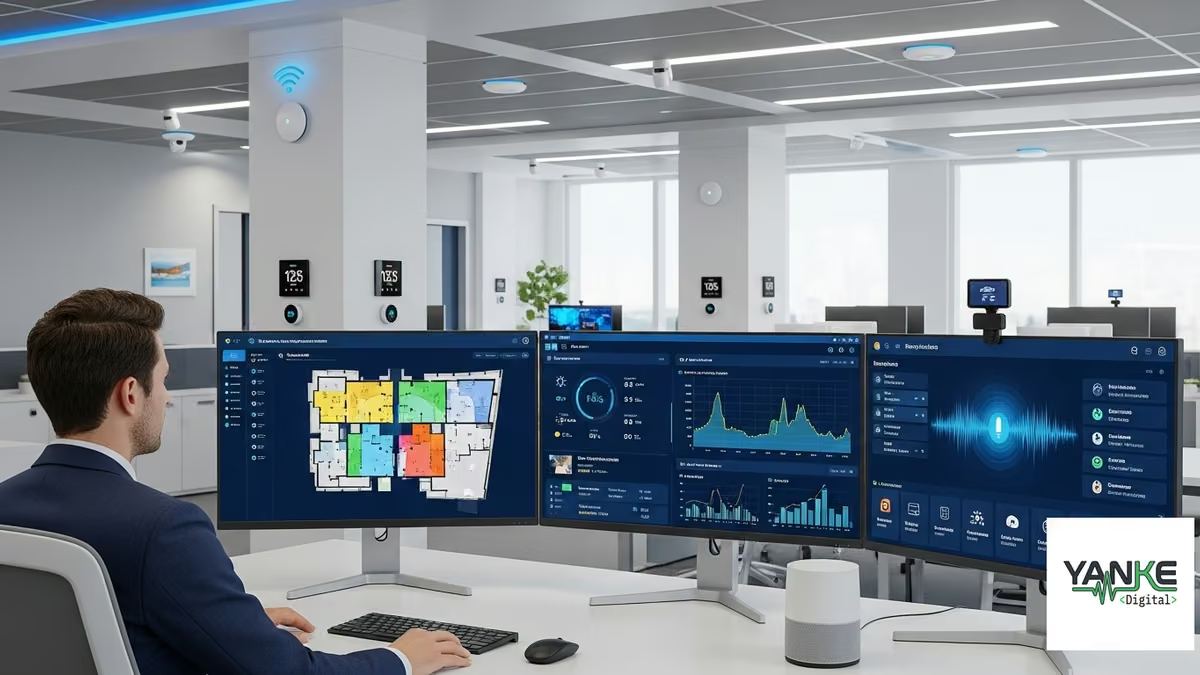
Voice control smart building integration has transformed how commercial and residential properties operate. From hands-free access control to voice-activated climate management, intelligent voice systems are becoming essential infrastructure for modern buildings. Whether you’re managing a multi-unit residential complex, commercial office, or single-family home, understanding how voice control integrates with your smart building ecosystem is critical to maximizing efficiency, security, and user experience.
At Yanke Digital, we design custom voice control smart building integration solutions that work seamlessly with industry-leading platforms like Alexa and Google Home. This guide covers everything you need to know about implementing voice control in smart buildings—from core technologies to practical deployment strategies.
What Is Voice Control Smart Building Integration?
Voice control smart building integration refers to the seamless connection of voice-activated assistants (like Amazon Alexa, Google Assistant, and Apple Siri) with your building’s automation systems. Rather than using physical switches, keypads, or mobile apps, occupants can control lighting, temperature, security, and access points using natural voice commands.
This integration goes beyond simple voice commands. Modern voice control smart building systems create a unified ecosystem where voice interfaces communicate with:
- Smart thermostats and climate control systems
- Security cameras and surveillance networks
- Smart locks and access control systems
- Lighting and occupancy sensors
- Intercoms and communication systems
- Environmental monitoring sensors
- Alarm and flood detection systems
The key difference between basic voice assistants and true voice control smart building integration is custom design and system-wide coordination. A properly integrated system ensures all devices work together intelligently, not as isolated voice-controlled gadgets.
Core Technologies Behind Voice Control Smart Buildings
Natural Language Processing (NLP)
Natural Language Processing is the AI technology that allows voice assistants to understand human speech. Instead of requiring exact commands, NLP lets users speak naturally: “Make it warmer in the conference room” rather than “Set temperature zone 3 to 72 degrees.”
For voice control smart building integration, advanced NLP systems can:
- Recognize context (understanding “it” refers to the current room)
- Handle accents and speech variations
- Process multi-step commands (“Lock the front door and arm the security system”)
- Learn user preferences over time
IoT (Internet of Things) Connectivity
Every device in your smart building—cameras, locks, thermostats, sensors—must communicate over a reliable network. Voice control smart building integration requires robust IoT infrastructure that connects these devices to a central hub or cloud platform.
Common connectivity protocols include:
- WiFi: Broad coverage, high bandwidth, ideal for residential and office spaces
- Zigbee/Z-Wave: Low-power mesh networks for sensors and battery-operated devices
- Thread: Modern mesh protocol offering reliability and low latency
- Bluetooth: Short-range but energy-efficient for personal devices
Cloud Integration & API Bridges
Voice assistants like Alexa and Google Home operate in the cloud. For voice control smart building integration to work, your building’s systems must connect to these cloud platforms through secure APIs (Application Programming Interfaces). These bridges translate voice commands into actions your building systems understand.
This is where custom software design becomes critical. Off-the-shelf integrations often lack the sophistication needed for commercial buildings or complex residential setups. Yanke Digital designs custom API bridges that ensure your specific systems work seamlessly with voice platforms.
Benefits of Voice Control Smart Building Integration
Enhanced User Experience & Accessibility
Voice control smart building integration removes friction from daily operations. Occupants no longer need to remember complex app interfaces or navigate multiple control systems. A single voice command can:
- Unlock doors and disarm security systems for authorized users
- Adjust temperature and lighting based on occupancy
- Request building services or maintenance
- Check security camera feeds or alarm status
For elderly residents, people with mobility challenges, or busy professionals, voice control dramatically improves accessibility and convenience.
Operational Efficiency & Cost Savings
Voice control smart building integration enables data-driven building management. When systems are fully integrated, facility managers gain visibility into:
- Real-time occupancy patterns
- Energy consumption by zone or device
- Maintenance alerts and predictive issues
- Security events and access logs
This data allows managers to optimize HVAC schedules, reduce energy waste, and address maintenance proactively—often reducing operational costs by 15-30%.
Improved Security & Access Control
Voice-activated access control adds a biometric layer to traditional smart locks. When properly integrated, voice control smart building systems can:
- Verify identity through voice recognition
- Grant temporary access to contractors or guests
- Log all access events for compliance and auditing
- Integrate with intercoms for two-way verification
- Trigger alerts if unauthorized access is attempted
For commercial buildings and multi-unit residential properties, this level of control is invaluable for security and liability management.
Scalability & Future-Proof Design
A well-designed voice control smart building integration system grows with your needs. Whether you’re adding new zones, integrating additional devices, or upgrading to newer platforms, a modular architecture ensures your investment remains relevant for years.
Alexa, Google Home & Enterprise Voice Solutions
Amazon Alexa for Smart Buildings
Amazon Alexa is the most widely deployed voice assistant in smart buildings. Alexa for Business offers enterprise-grade features including:
- Device management and fleet control
- Custom skills for building-specific commands
- Integration with AWS IoT services
- Advanced analytics and usage reporting
- Support for multi-building deployments
Yanke Digital integrates Alexa into voice control smart building systems for residential, multi-dwelling, and commercial properties across Saskatchewan. Our custom Alexa skills allow residents and staff to interact with your building’s unique systems naturally.
Google Home & Google Assistant Integration
Google Assistant powers voice control smart building integration through Google Home devices and Android platforms. Google’s strength lies in contextual understanding and cross-device coordination.
Key advantages for building integration:
- Superior natural language understanding
- Seamless integration with Google Workspace (for commercial buildings)
- Multi-user household management
- Routine automation (morning/evening sequences)
- Strong privacy controls and on-device processing options
Enterprise Voice Solutions & Custom Platforms
For large commercial buildings, multi-tenant properties, or specialized applications, enterprise voice solutions offer greater control and customization. These platforms include:
- Cisco Webex Voice: Integrated with building management systems
- Microsoft Cortana for Enterprise: Integration with Office 365 and Azure IoT
- Custom Voice Interfaces: Purpose-built systems for specific industries (healthcare, hospitality, manufacturing)
Yanke Digital specializes in designing custom voice control smart building integration solutions that combine the best of consumer platforms with enterprise-grade reliability and security.
Hands-Free Access Control: Voice-Activated Security
One of the most practical applications of voice control smart building integration is hands-free access control. Imagine arriving at your office with full hands—voice commands can unlock doors, disarm alarms, and grant access without touching anything.
Voice-Activated Smart Locks
Modern smart locks integrate with voice assistants to provide secure, convenient access. When properly configured, voice-activated smart locks can:
- Unlock doors for authorized users via voice command
- Require multi-factor authentication (voice + PIN)
- Create temporary access codes for guests or contractors
- Log all unlock events for security audits
- Work offline with manual override options
For residential properties, voice-activated smart locks eliminate the need for physical keys. For commercial buildings, they streamline employee access while maintaining detailed security logs.
Voice-Controlled Intercoms & Verification
Voice control smart building integration extends to intercom systems, enabling two-way voice communication integrated with access control. Residents or security staff can:
- Verify visitor identity before granting access
- Communicate with multiple units simultaneously
- Integrate video feeds with voice verification
- Create emergency broadcast capabilities
Alarm System Integration
Voice control smart building integration allows occupants to arm/disarm security systems, check alarm status, and receive voice alerts about security events. This requires robust encryption and authentication to prevent unauthorized access.
Voice Interface Commercial Systems: Enterprise Deployment
Conference Room & Meeting Space Automation
In commercial buildings, voice control smart building integration transforms meeting spaces. Conference rooms can be controlled entirely by voice:
- “Alexa, start the meeting” – lights dim, projector activates, temperature adjusts
- “Google, record this meeting” – video and audio capture begins
- “Set room temperature to 72 degrees” – HVAC adjusts automatically
- “End the meeting” – systems reset to default state
Facility Management & Maintenance Requests
Voice control smart building integration streamlines facility management. Employees can request maintenance, report issues, or check building status through voice commands integrated with work order systems.
Multi-Building & Campus Coordination
For organizations managing multiple buildings or campuses, voice control smart building integration provides unified control. Facility managers can monitor and control systems across all properties from a single interface.
Implementation Strategy: Deploying Voice Control Smart Building Integration
1. Assess Your Current Systems & Needs
Before implementing voice control smart building integration, conduct a thorough audit of:
- Existing smart devices and automation systems
- Network infrastructure and WiFi coverage
- Security requirements and compliance standards
- User needs and accessibility requirements
- Budget and timeline constraints
This assessment ensures your voice control solution aligns with your building’s unique characteristics.
2. Choose the Right Voice Platform
Decide whether to use consumer platforms (Alexa, Google Home), enterprise solutions, or a hybrid approach. Consider:
- Existing device ecosystem in your building
- Integration capabilities with your current systems
- Security and privacy requirements
- Support and maintenance resources
- Scalability for future expansion
3. Design Custom Integration Architecture
This is where Yanke Digital’s expertise becomes invaluable. Custom software design ensures your voice control smart building integration works seamlessly with your specific devices and workflows. We design:
- API bridges connecting voice platforms to building systems
- Custom voice skills and commands tailored to your building
- Authentication and authorization protocols
- Data flow and system redundancy
- User interface and voice command structure
4. Prioritize Security & Privacy
Voice control smart building integration introduces new security considerations:
- Encryption: All voice data and commands must be encrypted in transit and at rest
- Authentication: Implement multi-factor authentication for sensitive commands
- Voice Recognition: Use voice biometrics to verify user identity
- Access Logs: Maintain detailed records of all voice commands and system changes
- Privacy Controls: Allow users to disable recording and manage data retention
5. Plan for Network Infrastructure
Voice control smart building integration requires robust, reliable network connectivity. Ensure:
- WiFi coverage throughout the building with adequate bandwidth
- Redundant internet connections for critical systems
- Quality of Service (QoS) prioritization for voice traffic
- Network segmentation for security (IoT devices separate from corporate networks)
- Backup power systems for voice hubs and network equipment
6. Install & Configure Devices
Professional installation is critical for voice control smart building integration success. Yanke Digital handles:
- Strategic placement of voice hubs and speakers
- Integration with existing smart devices (locks, thermostats, cameras, sensors)
- Configuration of voice commands and automation routines
- Testing and optimization for accuracy and reliability
- Documentation and user training
7. User Training & Education
Complex technology requires clear education. We ensure occupants understand:
- Available voice commands and how to use them
- Security best practices (e.g., not sharing access codes)
- Privacy settings and data management
- Troubleshooting common issues
- How to request new features or report problems
Voice-Activated Building Automation: Practical Examples
Residential Home Automation
For single-family homes, voice control smart building integration creates seamless daily routines:
Morning Routine: “Alexa, good morning” triggers lights to gradually brighten, coffee maker to start, garage door to open, and security system to disarm.
Leaving Home: “Google, I’m leaving” locks all doors, arms the security system, adjusts thermostat to away mode, and turns off all lights.
Evening Comfort: “Alexa, movie time” dims lights, closes blinds, adjusts temperature, and activates entertainment systems.
Multi-Unit Residential (Apartments & Condos)
For apartment buildings and condos, voice control smart building integration improves both resident experience and property management:
- Unit-Level Control: Each resident controls their own apartment’s temperature, lighting, and locks via voice
- Building-Wide Services: Residents request maintenance, report issues, or check package delivery status through voice commands
- Common Area Management: Lobby lighting, elevator calls, and amenity room reservations can be voice-controlled
- Emergency Communication: Building management can broadcast emergency alerts through all voice systems
Commercial Office Buildings
In commercial settings, voice control smart building integration optimizes operations and employee experience:
- Access Control: Employees unlock doors and elevators with voice commands
- Meeting Rooms: Conference rooms automatically configure for meetings via voice
- Facility Requests: Employees request cleaning, maintenance, or IT support through voice
- Energy Management: Occupancy-based voice commands help optimize HVAC and lighting
- Security: After-hours voice verification for building access
Challenges & Solutions in Voice Control Smart Building Integration
Privacy & Data Security Concerns
Challenge: Voice assistants continuously listen for wake words, raising privacy concerns about data collection and storage.
Solution: Implement on-device processing where possible, use encrypted connections, maintain transparent privacy policies, and allow users to review/delete voice recordings. Yanke Digital ensures all voice control smart building integration systems comply with privacy regulations.
Accuracy & False Activations
Challenge: Voice recognition errors can trigger unintended commands or fail to recognize legitimate requests.
Solution: Use multi-factor authentication for sensitive commands, implement confirmation steps, and continuously train voice models. Our custom voice control smart building integration systems include fallback mechanisms and manual overrides.
Network Reliability & Latency
Challenge: Voice commands require real-time network connectivity. Poor WiFi or internet outages can disable the system.
Solution: Design redundant network architecture with backup internet connections, local processing capabilities, and manual override systems. Critical functions (security, emergency access) must work even if cloud connectivity is lost.
Device Compatibility & Integration Complexity
Challenge: Not all smart devices support voice control, and integration between different manufacturers’ systems can be problematic.
Solution: Work with a system integrator like Yanke Digital who understands device compatibility and can design custom bridges to connect disparate systems. We ensure all your devices work together seamlessly.
User Adoption & Training
Challenge: Complex voice control smart building integration systems require user education. Without proper training, occupants may not use the system effectively.