A smart lock audit for healthcare facilities is no longer optional—it’s a critical component of modern infection prevention and security strategy. Healthcare environments demand more than standard locks. They require integrated systems that balance patient safety, staff efficiency, regulatory compliance, and infection control. When doors, medication storage, and restricted areas rely on outdated or fragmented access systems, healthcare facilities face compounding risks: unauthorized access, cross-contamination pathways, audit failures, and operational inefficiencies that compromise care quality.
This guide explores why healthcare facilities need comprehensive smart lock audits, what to evaluate, and how modern access control systems prevent infection while strengthening security.
Why Healthcare Facilities Need Smart Lock Audits
Healthcare environments are uniquely vulnerable. Unlike standard commercial buildings, hospitals, clinics, and long-term care facilities must protect patient data, prevent unauthorized medication access, control infection vectors, and maintain 24/7 operational integrity. A smart lock audit evaluates whether your current access control systems meet these demands.
Key reasons healthcare facilities require audits:
- Infection Prevention: Uncontrolled access to high-risk areas (ICUs, operating rooms, isolation wards) increases cross-contamination risk. Smart lock audits identify gaps where unauthorized personnel could enter restricted zones.
- HIPAA & Regulatory Compliance: Access logs from modern smart lock systems provide audit trails required by HIPAA, state health departments, and accreditation bodies. Legacy locks leave no accountability record.
- Medication Security: Controlled substance storage and pharmacy access must be restricted to authorized personnel. Audits verify that smart locks prevent diversion and unauthorized dispensing.
- Staff Safety: Panic buttons, emergency egress, and controlled access to violent patient areas require intelligent systems that balance security with rapid response.
- Operational Efficiency: Manual key management creates bottlenecks. Smart locks reduce lost keys, unauthorized copies, and time spent on access requests.
Understanding Smart Lock Systems in Healthcare Settings
Not all smart locks are created equal. Healthcare-grade smart lock systems differ significantly from residential or standard commercial solutions. Understanding these differences is essential for a meaningful audit.
Smart Locks vs. Full Access Control Systems
A common misconception is that individual smart locks solve healthcare access challenges. While smart locks offer convenience (keypad entry, mobile credentials, audit logs), they often function in isolation. Healthcare facilities typically need integrated access control systems that:
- Centralize credential management across all doors and zones
- Enforce time-based access rules (e.g., staff can only enter pharmacy during shift hours)
- Integrate with building management, surveillance, and alarm systems
- Provide real-time alerts when unauthorized access attempts occur
- Support emergency lockdown and mass credential revocation
- Maintain redundancy if network connectivity fails
A smart lock audit should evaluate whether your facility uses standalone smart locks or a cohesive access control ecosystem. Many healthcare facilities discover they’ve installed smart locks piecemeal without central management—creating security blind spots and compliance gaps.
Key Technologies in Healthcare Smart Lock Systems
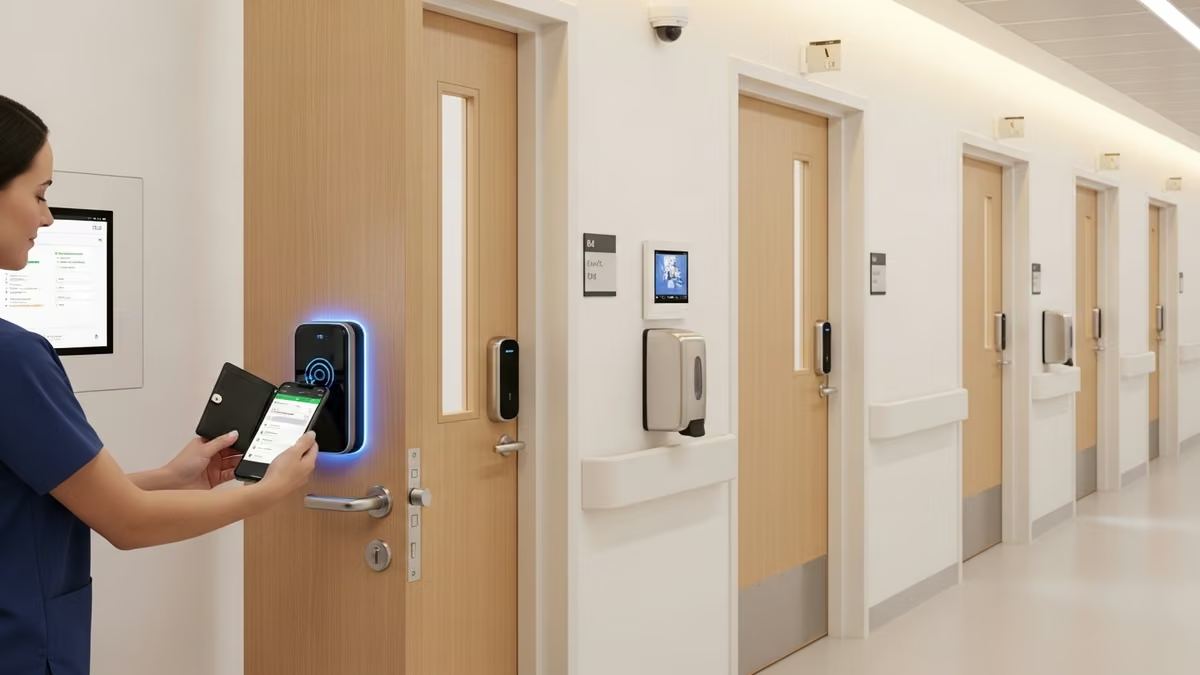
- RFID & Proximity Cards: Staff badges that grant access without physical contact—reducing surface contamination in high-touch environments.
- Mobile Credentials: Smartphone-based access eliminates lost badges and enables rapid credential revocation when staff leave.
- Biometric Integration: Fingerprint or facial recognition for high-security areas (pharmacy, controlled substance storage) ensures only authorized individuals access sensitive zones.
- Keypad Systems: PIN codes for emergency access, with audit logs tracking who entered when.
- Cloud & On-Premise Management: Centralized platforms that allow real-time access control, remote credential provisioning, and comprehensive reporting.
- Integration with Building Systems: Smart locks that communicate with HVAC, surveillance, and alarm systems to create coordinated security responses.
Conducting a Smart Lock Audit: Key Areas to Evaluate
A comprehensive smart lock audit for healthcare facilities should assess multiple dimensions. Here’s what to evaluate:
1. Infection Prevention & Clinical Safety
- Isolation Room Access: Are COVID-19, TB, or other isolation rooms restricted to trained staff only? Can access be revoked instantly if a patient becomes non-compliant?
- Operating Room & Sterile Field Protection: Do smart locks prevent unauthorized entry during procedures? Is access logged for infection control investigations?
- ICU & High-Acuity Areas: Are these zones restricted to assigned staff? Can family members or visitors be granted temporary, time-limited access?
- Medication & Controlled Substance Storage: Are pharmacy areas, narcotic cabinets, and medication rooms protected by smart locks with biometric or multi-factor authentication?
- Hand Hygiene Compliance: Do smart lock systems integrate with hand sanitizer dispensers or monitoring to enforce hygiene protocols before entry to critical areas?
2. Regulatory & Compliance Requirements
- HIPAA Audit Trails: Can your smart lock system generate detailed access logs (who, when, where) required for HIPAA audits and breach investigations?
- State & Local Health Department Standards: Does your system meet infection prevention standards set by your state health department or accrediting body (The Joint Commission, CMS)?
- DEA Compliance (for Controlled Substances): If your facility dispenses controlled substances, does your access control system meet DEA requirements for secure storage and access logging?
- Emergency Preparedness: Can your smart lock system support emergency lockdown, mass credential revocation, and rapid access restoration during crises?
3. System Integration & Interoperability
- Centralized Management Platform: Is there a single dashboard where administrators can manage all access, view real-time alerts, and generate compliance reports?
- Integration with Existing Systems: Do smart locks communicate with your EHR, badge system, surveillance cameras, and alarm systems? Or do they operate in silos?
- Credential Standardization: Are all staff using the same credential format (RFID, mobile, biometric) across the facility, or are there multiple incompatible systems?
- Redundancy & Failover: If your network goes down, can doors still operate? Are there backup power supplies and offline access capabilities?
4. Operational Efficiency & User Experience
- Access Request Workflow: How long does it take for new staff to receive access credentials? Are there bottlenecks in the provisioning process?
- Credential Lifecycle Management: When staff leave, are credentials revoked immediately? Are there orphaned accounts or lost badges creating security risks?
- Emergency Access Procedures: Can authorized personnel quickly grant temporary access during emergencies without compromising security?
- Staff Training & Adoption: Do staff understand how to use the system? Are there high rates of failed access attempts or workarounds (propping doors, sharing credentials)?
5. Physical Security & Hardware Assessment
- Lock Condition & Maintenance: Are smart locks functioning properly? Are there signs of tampering, wear, or failed components?
- Door Frame & Hardware Integrity: Even the best smart lock is ineffective if the door frame is weak or hinges are compromised.
- Credential Reader Placement: Are readers positioned to prevent tailgating (one person following another through a secured door)?
- Environmental Factors: Do smart locks function reliably in high-humidity areas (bathrooms, laundries) or extreme temperatures?
Common Smart Lock Vulnerabilities in Healthcare Facilities
During audits, healthcare facilities frequently discover preventable security and infection control gaps:
Tailgating & Unauthorized Access
Staff hold doors open for colleagues, visitors, or contractors without verifying credentials. Smart lock audits should assess whether facilities have implemented anti-tailgating measures (mantrap entries, vestibules, surveillance monitoring) in high-risk areas.
Credential Sharing & Workarounds
When access is inconvenient, staff share badges or credentials, defeating audit trails and enabling unauthorized access. Audits reveal whether facilities have addressed root causes (slow provisioning, unclear access policies) or simply installed locks without addressing behavior.
Lack of Centralized Management
Many healthcare facilities have installed smart locks from multiple vendors without a unified management platform. This creates administrative chaos: different credentials for different areas, no coordinated emergency response, and fragmented audit logs that don’t meet compliance requirements.
Insufficient Audit Trail Retention
Some smart lock systems store only recent access logs (30-90 days). Healthcare facilities need multi-year retention for infection control investigations, legal discovery, and regulatory audits. A smart lock audit should verify that your system meets retention requirements.
Network Dependency Without Failover
Cloud-based smart lock systems are convenient but risky if they lack offline functionality. Network outages should not prevent authorized staff from accessing critical areas. Audits should confirm that your system has local processing and battery backup.
Smart Lock Audit for Healthcare Facilities: Implementation Steps
A structured audit process ensures comprehensive evaluation and actionable recommendations:
Step 1: Define Scope & Stakeholders
Identify which areas, departments, and systems will be audited. Assemble a team including IT, security, infection prevention, nursing leadership, and facilities management. Each perspective is essential for identifying gaps.
Step 2: Document Current State
Map all access-controlled areas, document which locks are installed, identify credential types in use, and review existing access policies. This baseline reveals fragmentation and inconsistencies.
Step 3: Assess Against Standards
Evaluate your current system against HIPAA requirements, state health department standards, infection prevention guidelines (CDC, APIC), and industry best practices. Identify specific compliance gaps.
Step 4: Conduct Physical & Technical Testing
Test smart locks for proper function, verify audit logs are being recorded, attempt unauthorized access to identify vulnerabilities, and assess system performance under load.
Step 5: Interview Staff & Observe Workflows
Talk to nurses, physicians, housekeeping, security, and IT staff. Observe how they actually use the system. Identify workarounds, pain points, and training gaps that indicate system design problems.
Step 6: Generate Findings & Recommendations
Prioritize findings by risk level (critical, high, medium, low). Provide specific, actionable recommendations with implementation timelines and estimated costs. Include both quick wins and long-term improvements.
Infection Prevention Benefits of Modern Smart Lock Systems
Beyond security, modern smart lock systems directly support infection prevention objectives:
Contactless Access Reduces Surface Contamination
Mobile credentials and proximity readers eliminate the need to touch keypads or handles, reducing pathogen transmission in high-touch environments. This is particularly valuable in isolation rooms, ICUs, and operating rooms.
Rapid Isolation & Quarantine Response
During outbreaks, administrators can instantly restrict access to affected areas, revoke credentials for exposed staff, and create temporary isolation zones—all from a central platform. This agility is impossible with manual locks.
Audit Trail Support for Outbreak Investigation
When infection control teams investigate outbreaks, detailed access logs reveal who entered which areas when. This data is essential for identifying transmission pathways and implementing targeted interventions.
Enforcement of Hygiene Protocols
Advanced systems can integrate hand hygiene monitoring, requiring staff to sanitize before accessing critical areas. Some systems log compliance data for quality improvement initiatives.
Visitor & Contractor Management
Smart lock systems enable temporary, time-limited credentials for visitors and contractors, preventing unauthorized access to patient care areas while maintaining operational flexibility.
Choosing the Right Smart Lock System for Your Healthcare Facility
After completing your audit, you’ll likely need to upgrade or expand your smart lock system. Key selection criteria:
- Healthcare-Specific Certification: Look for systems certified for healthcare environments (HIPAA-compliant, FDA-cleared if applicable, validated for infection prevention).
- Centralized Management Platform: Ensure a single dashboard for credential management, access control, audit logs, and emergency response.
- Integration Capabilities: Verify compatibility with your EHR, badge system, surveillance, and building management systems.
- Scalability: Choose a system that can grow with your facility, supporting additional doors, zones, and credential types without major overhauls.
- Redundancy & Failover: Confirm offline functionality, battery backup, and failover capabilities for network outages.
- Audit Trail & Reporting: Verify multi-year retention, detailed logging, and compliance-ready reporting for HIPAA, state health departments, and accreditation bodies.
- Vendor Support & Training: Ensure the vendor provides implementation support, staff training, and ongoing technical support.
Working With System Integrators for Healthcare Smart Lock Implementation
Implementing a comprehensive smart lock system in a healthcare facility is complex. Working with experienced system integrators ensures proper design, installation, integration, and staff training. A qualified integrator will:
- Conduct a thorough audit of your current systems and workflows
- Design a custom solution tailored to your facility’s clinical, operational, and compliance needs
- Integrate smart locks with your existing building systems (HVAC, surveillance, alarms, EHR)
- Manage installation with minimal disruption to patient care
- Provide comprehensive staff training and documentation
- Offer ongoing support and maintenance to ensure reliable operation
At Yanke Digital, we specialize in designing and integrating smart lock systems for healthcare facilities, multi-dwelling properties, and commercial buildings across Saskatchewan. We understand the unique security, infection prevention, and compliance requirements of healthcare environments. Our approach combines industry-leading smart lock technology with custom software design, ensuring your system is intuitive, reliable, and fully integrated with your existing infrastructure.
Compliance & Regulatory Considerations
Healthcare smart lock systems must meet multiple regulatory frameworks:
HIPAA Security Rule
The HIPAA Security Rule requires access controls, audit logs, and accountability mechanisms. Your smart lock system must support these requirements and provide documentation for compliance audits.
State Health Department Standards
Most states have specific infection prevention and security standards for healthcare facilities. Your smart lock audit should verify compliance with your state’s requirements.
The Joint Commission Standards
If your facility is accredited by The Joint Commission, your access control system must meet their standards for security, infection prevention, and emergency preparedness.
DEA Requirements (for Controlled Substances)
Facilities that dispense controlled substances must meet DEA requirements for secure storage and access logging. Smart lock systems must support these requirements.
Measuring Success: Key Performance Indicators for Smart Lock Systems
After implementing a smart lock system, track these metrics to measure success:
- Unauthorized Access Attempts: Monitor and investigate failed access attempts. Decreasing trends indicate improved security.
- Audit Trail Completeness: Verify that 100% of access events are logged and retained. Gaps indicate system problems.
- Staff Provisioning Time: Track how quickly new staff receive access credentials. Target: same-day provisioning for most roles.
- Credential Revocation Time: When staff leave, how quickly are credentials revoked? Target: immediate revocation upon termination.
- System Uptime: Monitor availability and failover performance. Target: 99.9% uptime with zero impact on authorized access during outages.
- Compliance Audit Results: Track findings from HIPAA, state health department, and accreditation audits. Smart lock improvements should reduce access-related findings.
- Staff Satisfaction: Survey staff on system usability and convenience. High satisfaction indicates good design and training.
Next Steps: Schedule Your Smart Lock Audit
Healthcare facilities that haven’t conducted a recent smart lock audit are operating with unknown security and compliance risks. Whether you’re concerned about infection prevention, regulatory compliance, operational efficiency, or all three, a comprehensive audit is the first step toward a modern, integrated access control system.
Yanke Digital offers expert smart lock audits and custom system design for healthcare facilities across Saskatchewan. We evaluate your current systems, identify gaps, and recommend solutions tailored to your clinical, operational, and compliance needs. Our team works closely with your infection prevention, security, IT, and clinical leadership to ensure the final system meets everyone’s requirements.
Contact Yanke Digital today to schedule your smart lock audit and take the first step toward a more secure, efficient, and compliant healthcare facility. Let’s discuss how modern smart lock systems can enhance infection prevention while strengthening security across your organization.