Senior living communities face a unique challenge: balancing resident independence with comprehensive safety oversight. Smart building integration for senior living communities safety has emerged as the transformative solution that addresses this tension head-on. By combining intelligent automation, real-time monitoring, and seamless caregiver coordination technology, modern smart buildings enable seniors to age in place with confidence while giving families and care teams the visibility they need.
This comprehensive guide explores how smart building technology is reshaping senior care environments—from fall detection systems that respond instantly to climate controls that prevent health complications. Whether you’re managing a residential community, assisted living facility, or independent living complex, understanding these solutions is essential for delivering safe, dignified care.
Why Smart Building Integration Matters for Senior Living Communities
The aging population is growing faster than ever. According to the U.S. Census Bureau, adults 65 and older will represent nearly 23% of the population by 2060. This demographic shift has created unprecedented demand for senior living solutions that don’t compromise on safety or quality of life.
Traditional senior living facilities rely on manual monitoring, scheduled check-ins, and reactive response protocols. Smart building integration transforms this model into a proactive, data-driven ecosystem where:
- Environmental hazards are detected and mitigated before they cause harm
- Staff respond to emergencies in seconds, not minutes
- Residents maintain independence while benefiting from constant oversight
- Operational efficiency reduces costs and improves care quality
- Real-time data informs better health and safety decisions
For senior living communities, this isn’t just about technology—it’s about dignity, autonomy, and peace of mind for residents and their families.
Core Safety Features in Smart Building Senior Living Technology
Fall Detection Systems
Falls are the leading cause of injury-related death among older adults. Every 11 seconds, an older adult is treated in an emergency room for a fall, and every 19 minutes, an older adult dies from a fall-related injury. Smart building integration for senior living communities safety includes advanced fall detection systems that work 24/7.
Modern fall detection uses multiple technologies:
- Wearable sensors: Accelerometers and gyroscopes detect sudden changes in movement patterns and alert staff immediately
- Environmental sensors: Motion and pressure sensors in rooms identify unusual patterns that may indicate a fall
- Computer vision: AI-powered cameras recognize falls without recording identifying details, preserving privacy
- Smart flooring: Pressure-sensitive surfaces detect falls and automatically alert caregivers
When a fall is detected, the system automatically notifies staff, logs the incident, and can trigger emergency protocols—reducing response time from minutes to seconds.
Caregiver Coordination Technology
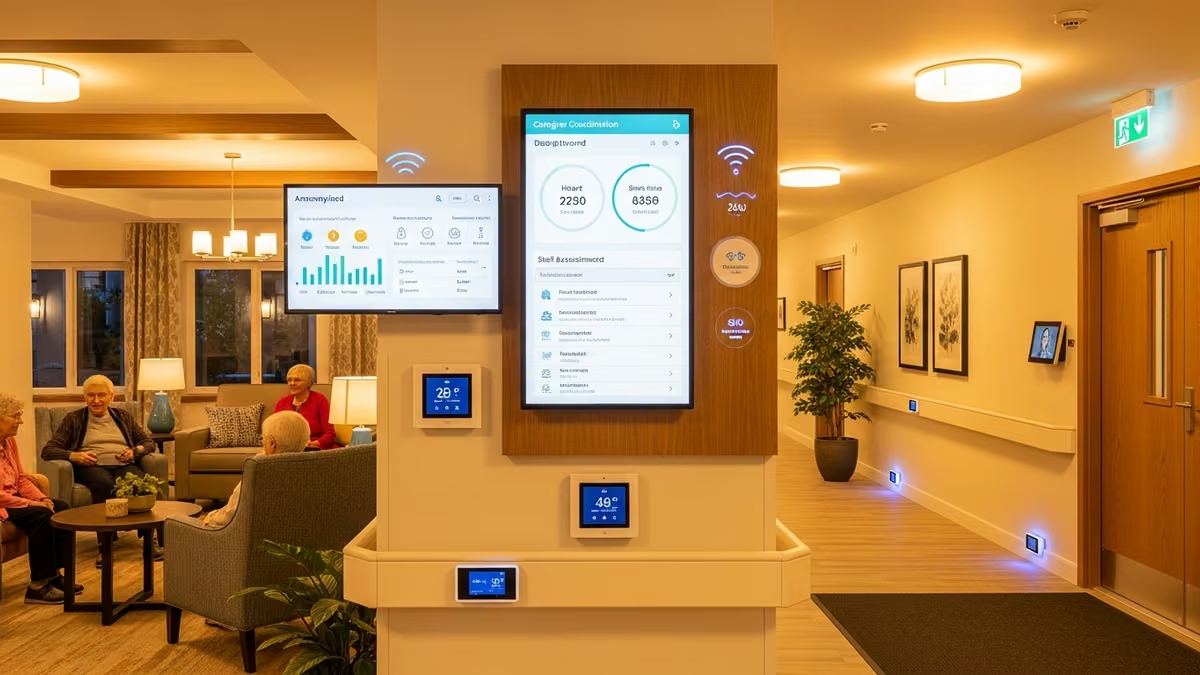
Effective senior care requires seamless communication between residents, family members, and care staff. Smart building systems integrate caregiver coordination technology that centralizes information and streamlines workflows.
Key coordination features include:
- Real-time alerts for health events, medication reminders, and activity changes
- Centralized dashboards showing resident status across the entire community
- Automated task assignment and completion tracking for care staff
- Secure communication channels between residents, families, and caregivers
- Documentation and compliance reporting integrated into daily workflows
This integration eliminates information silos, reduces missed communications, and ensures every team member has the context they need to provide excellent care.
Environmental Monitoring & Climate Control
Senior residents are particularly vulnerable to temperature extremes, poor air quality, and humidity imbalances. Smart building systems monitor and automatically adjust environmental conditions to prevent health complications.
Smart environmental controls include:
- Intelligent thermostats: Maintain optimal temperatures for health and comfort, with alerts if conditions drift outside safe ranges
- Air quality monitoring: Track CO₂, humidity, and particulate levels; automatically adjust ventilation
- Flood and water detection: Sensors prevent water damage and mold growth that can trigger respiratory issues
- Lighting automation: Circadian rhythm lighting supports healthy sleep patterns and reduces fall risk
These systems run automatically in the background, creating a safe microclimate for each resident without requiring any action on their part.
Access Control & Security Systems
Senior living communities must balance resident freedom with security. Smart access control systems enable this balance through intelligent locks, intercoms, and monitoring.
Smart security features include:
- Keyless smart locks that residents can operate without fumbling with keys
- Video intercoms allowing residents to verify visitors before granting access
- Perimeter monitoring that alerts staff if residents wander into unsafe areas
- Visitor management systems that log entries and exits for security and compliance
- Emergency lockdown capabilities for facility-wide safety protocols
These systems protect residents while maintaining the independence and dignity that quality senior living demands.
How Smart Building Integration Enhances Senior Independence
A common misconception is that smart building technology in senior living communities means constant surveillance and loss of privacy. In reality, well-designed systems do the opposite—they enable greater independence by removing barriers and providing support only when needed.
Voice-Activated Controls & Accessibility
Residents with mobility limitations or arthritis can control lighting, temperature, doors, and entertainment systems using voice commands. This eliminates frustration and maintains autonomy in their living space.
Medication & Appointment Reminders
Smart systems send gentle, personalized reminders for medications and appointments. Residents can confirm completion independently, reducing caregiver burden and supporting medication adherence.
Activity Monitoring Without Surveillance
Privacy-preserving sensors track activity patterns (like movement between rooms, sleep quality, and bathroom visits) without recording video or audio. This data helps identify health changes early while respecting resident privacy.
Family Connection & Transparency
Residents and families can access secure portals showing health metrics, activity summaries, and care notes. This transparency builds trust and keeps families informed without requiring constant phone calls.
Implementation: Building a Smart Senior Living Ecosystem
Implementing smart building integration for senior living communities safety requires careful planning, the right technology partners, and a commitment to resident-centered design. Here’s how successful communities approach it:
Phase 1: Assessment & Planning
Start by understanding your community’s specific needs:
- What are the most common safety incidents or operational challenges?
- What are residents’ and families’ primary concerns?
- What existing systems or infrastructure can be leveraged?
- What’s your budget and timeline for implementation?
- What staff training and change management will be required?
This assessment phase ensures your technology investment directly addresses real problems rather than adding complexity.
Phase 2: Technology Selection & Integration
Choose systems that work together seamlessly. The best smart building solutions integrate multiple devices and platforms into a unified ecosystem rather than creating isolated silos.
Key selection criteria:
- Interoperability: Can systems communicate with each other and share data?
- Scalability: Will the system grow with your community?
- User-friendliness: Can staff and residents actually use it without extensive training?
- Security & privacy: Are resident data and facility systems protected?
- Vendor support: Will your technology partner provide ongoing maintenance and updates?
Working with experienced system integrators ensures your technology choices work together effectively and deliver real value.
Phase 3: Pilot & Rollout
Start with a pilot program in one unit or building. This allows you to identify issues, train staff, and refine processes before full-scale deployment. Gather feedback from residents, families, and staff to continuously improve the system.
Phase 4: Training & Change Management
Technology only works if people use it correctly. Invest in comprehensive training for:
- Care staff on emergency protocols and system response procedures
- Residents on how to use voice controls, request assistance, and access family portals
- Families on how to monitor their loved one’s status and communicate with staff
- Management on data analysis and operational optimization
Real-World Benefits: What Senior Living Communities Achieve
Communities that successfully implement smart building integration for senior living communities safety report measurable improvements:
- Reduced fall-related injuries: Early detection and rapid response prevent serious harm
- Improved medication adherence: Automated reminders increase compliance rates
- Faster emergency response: Staff respond to health events in seconds instead of minutes
- Better staff efficiency: Automation reduces routine tasks, allowing caregivers to focus on resident interaction
- Enhanced family satisfaction: Transparency and communication reduce anxiety and build trust
- Operational cost reduction: Preventive monitoring reduces hospitalizations and emergency interventions
- Regulatory compliance: Automated documentation and monitoring support compliance with health and safety regulations
Addressing Privacy & Ethical Concerns
Privacy is a legitimate concern in any smart building environment, especially in senior living where residents may be vulnerable. Ethical implementation requires:
- Transparency: Residents and families understand what’s being monitored and why
- Consent: Residents have meaningful choice about which systems they participate in
- Data security: All resident information is encrypted and protected from unauthorized access
- Minimal collection: Systems collect only the data necessary for safety and care, not comprehensive surveillance
- Clear policies: Written policies govern how data is used, stored, and shared
- Regular audits: Independent reviews ensure systems operate as intended and respect resident privacy
When implemented ethically, smart building technology enhances both safety and dignity—not at the expense of one or the other.
Choosing the Right Technology Partner for Your Senior Living Community
The difference between a successful smart building implementation and a frustrating one often comes down to your technology partner. Look for providers who:
- Understand senior living: They’ve worked with communities like yours and understand the unique challenges
- Design custom solutions: They don’t just install off-the-shelf products; they design systems tailored to your specific needs
- Prioritize integration: They ensure all devices and platforms work together seamlessly
- Provide comprehensive support: Training, maintenance, and ongoing optimization are included, not add-ons
- Emphasize user experience: Systems are designed to be intuitive for residents, staff, and families
- Maintain security standards: They follow industry best practices for data protection and system security
At Yanke Digital, we specialize in designing and integrating smart building solutions for residential and commercial communities across Saskatchewan. We understand that every senior living facility is unique, which is why we create custom systems that address your specific safety, operational, and care coordination challenges. Our approach combines industry-leading technology with expert integration and ongoing support to ensure your smart building investment delivers real value for residents, families, and staff.
Future-Proofing Your Senior Living Technology
Technology evolves rapidly. When you invest in smart building integration for senior living communities safety, ensure your systems can adapt and grow:
- Open standards: Choose systems based on open protocols that work with multiple vendors
- Modular design: Add new capabilities without replacing existing infrastructure
- Regular updates: Ensure your provider delivers security patches and feature improvements
- Vendor partnerships: Work with providers who actively integrate emerging technologies
- Staff training: Invest in ongoing education so your team can leverage new capabilities
A well-designed smart building system should serve your community for 10+ years while adapting to new technologies and changing needs.
Getting Started: Next Steps for Your Senior Living Community
Ready to explore how smart building integration can enhance safety and independence in your senior living community? Here’s how to begin:
- Define your priorities: What are your top 3-5 safety or operational challenges?
- Research solutions: Look at case studies and speak with other communities using smart building technology
- Assess your infrastructure: Understand your current systems and what can be leveraged
- Consult with experts: Work with system integrators who understand senior living and can recommend tailored solutions
- Plan your implementation: Develop a realistic timeline and budget that includes training and change management
- Start with a pilot: Test systems in one area before committing to facility-wide deployment
If you’re in Saskatchewan and ready to discuss how smart building integration can transform your senior living community, contact Yanke Digital for a consultation. We’ll help you design a custom solution that prioritizes resident safety, independence, and dignity while improving operational efficiency and staff satisfaction.
Smart building technology isn’t about replacing human care—it’s about empowering caregivers to provide better care, enabling residents to maintain independence, and giving families peace of mind. When implemented thoughtfully, it’s a win for everyone.