
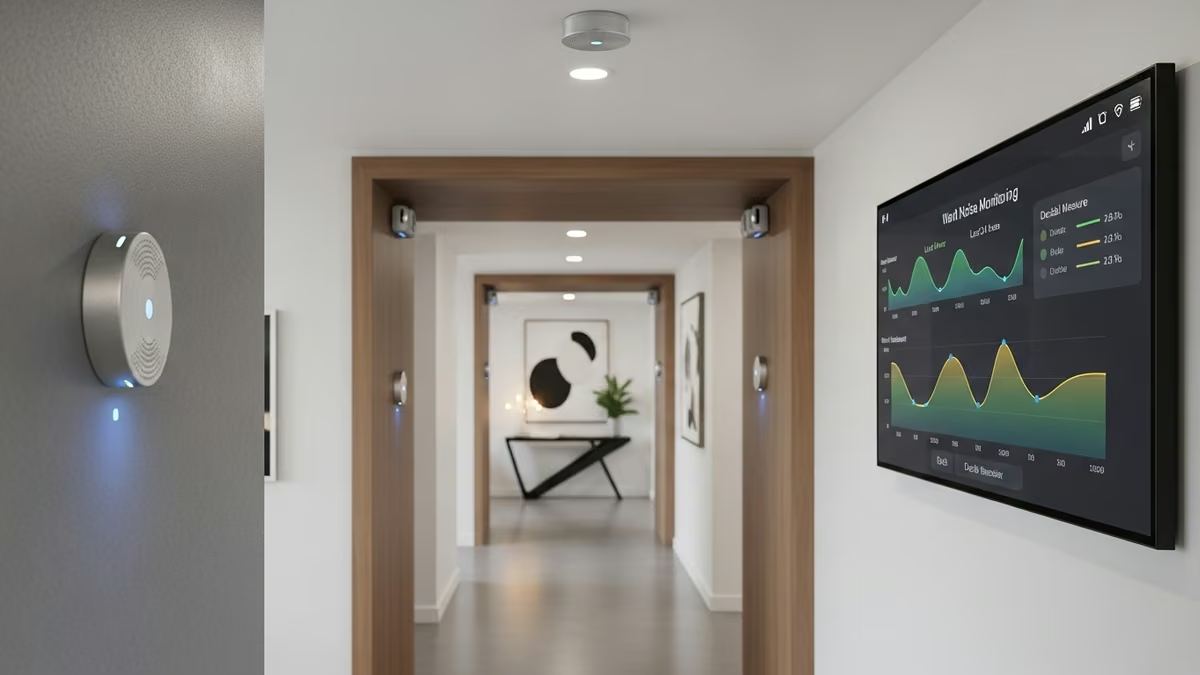
Noise complaints are among the most common issues property managers face in multi-dwelling units. Tenant disputes over sound levels can escalate quickly, damage community relationships, and lead to costly turnover. Smart noise monitoring with advanced sensors offers a data-driven solution that transforms how apartment buildings, condos, and multi-family properties handle acoustic issues. Instead of relying on subjective complaints and manual investigations, noise monitoring multi-dwelling units smart sensors provide objective measurements, early detection, and automated alerts that help prevent conflicts before they become problems.
At Yanke Digital, we specialize in integrating smart sensor systems into residential and commercial properties across Saskatchewan. Our approach to noise monitoring goes beyond simple detection—we design complete solutions that protect your property, support your staff, and create a more peaceful living environment for all residents.
Why Noise Monitoring Matters in Multi-Dwelling Units
Noise-related complaints represent a significant operational and financial burden for property managers. According to industry data, noise disputes are among the top three reasons residents break leases early, directly impacting occupancy rates and revenue.
The challenge isn’t just managing complaints—it’s managing them fairly and consistently. Without objective data, property managers often face:
- Inconsistent enforcement: Relying on subjective complaints leads to perceived bias and tenant frustration
- Staff burnout: Manual investigation and mediation consume significant time and resources
- Escalation: Unresolved disputes damage community morale and increase turnover
- Liability concerns: Without documentation, property managers lack evidence to support enforcement actions
- Emotional fatigue: Residents feel unheard when complaints aren’t addressed with data-backed solutions
Smart sensor technology changes this dynamic by providing objective, timestamped acoustic data that removes guesswork and supports fair, consistent policy enforcement.
How Smart Noise Sensors Work in Multi-Dwelling Properties
Modern noise monitoring systems use strategically placed acoustic sensors to continuously measure sound levels throughout a property. Here’s how the technology functions:
Real-Time Sound Level Detection
Sensors measure decibel levels in real-time, capturing acoustic data 24/7. This continuous monitoring means you’re not dependent on complaints to identify problems—you detect issues as they occur.
Threshold-Based Alerts
Property managers set noise thresholds based on lease agreements and local bylaws. When sound levels exceed these limits, the system automatically triggers alerts, enabling rapid response before situations escalate.
Timestamped Data Logging
Every noise event is recorded with precise timestamps and decibel measurements. This documentation provides objective evidence for lease enforcement, dispute resolution, and tenant communication.
Integration with Building Management Systems
Smart noise sensors integrate seamlessly with your existing building automation platform, allowing centralized monitoring alongside other environmental controls like climate, security, and access systems.
Key Benefits of Noise Monitoring for Multi-Dwelling Units
Objective Enforcement & Reduced Disputes
When you can show a tenant exactly when noise violations occurred and provide timestamped decibel readings, disputes become data-driven conversations rather than “he said, she said” conflicts. This objectivity reduces perceived bias and builds trust in your enforcement policies.
Improved Tenant Retention
Residents who feel their noise concerns are being taken seriously—and backed by technology—are significantly more likely to renew leases. A quieter, better-managed community directly improves retention rates and reduces costly turnover.
Operational Efficiency
Automated alerts and centralized monitoring reduce the time staff spends investigating complaints and mediating disputes. Your team can focus on proactive management rather than reactive firefighting.
Compliance & Documentation
Timestamped sensor data provides the documentation you need to enforce lease terms consistently and defend your decisions if disputes escalate. This creates a clear audit trail for compliance purposes.
Community Reputation
Properties known for proactive noise management attract quality residents and command higher rents. A reputation for peaceful, well-managed communities is a competitive advantage in the rental market.
Smart Sensors vs. Traditional Complaint-Based Approaches
The difference between reactive and proactive noise management is significant:
Traditional Method: Complaint-Driven Response
- Residents submit complaints to management
- Staff investigates after the fact (often finding no evidence)
- Enforcement decisions rely on subjective judgment
- Disputes escalate due to perceived inconsistency
- Documentation is incomplete or anecdotal
Smart Sensor Approach: Data-Driven Prevention
- Continuous monitoring detects violations automatically
- Alerts trigger immediately when thresholds are exceeded
- Objective data supports fair, consistent enforcement
- Disputes are resolved with evidence, not opinions
- Complete audit trail documents all incidents
The result: fewer disputes, faster resolution, and a more peaceful community.
Designing a Noise Monitoring System for Your Multi-Dwelling Property
Effective noise monitoring requires thoughtful system design tailored to your property’s specific layout, resident demographics, and operational needs.
Sensor Placement Strategy
Sensors should be strategically positioned in common areas, hallways, and problem zones identified through historical complaint data. For apartment buildings, placement in shared spaces (lobbies, corridors, recreation areas) captures the most relevant acoustic data without requiring access to individual units.
Threshold Configuration
Work with your property management team to establish noise thresholds that align with your lease terms and local noise bylaws. Different times of day may warrant different thresholds—for example, stricter limits during quiet hours (typically 10 PM to 7 AM).
Integration with Existing Systems
Modern smart sensors integrate with your building management platform, creating a unified ecosystem. This means noise data works alongside security cameras, access control, climate monitoring, and other systems for comprehensive property oversight.
Staff Training & Protocols
Implementing noise monitoring technology requires clear protocols for how staff responds to alerts, communicates with residents, and documents incidents. Proper training ensures consistent, professional enforcement.
Addressing Privacy & Tenant Relations
A common concern with noise monitoring is tenant privacy. The good news: modern smart sensors measure sound levels only—they don’t record conversations or identify specific residents. They’re acoustic measurement devices, not surveillance equipment.
Best practices for maintaining trust:
- Transparent communication: Inform residents about the noise monitoring system during lease signing and in building communications
- Clear policies: Publish noise thresholds and enforcement procedures so residents understand expectations
- Fair application: Enforce policies consistently across all units and residents
- Education: Help residents understand how the system works and why it benefits the community
- Dispute resolution: Use sensor data to resolve conflicts fairly, not punitively
When implemented transparently, noise monitoring systems actually improve tenant relations by creating a fairer, more peaceful community.
Noise Monitoring & Resident Retention: The Connection
Research consistently shows that noise is a leading factor in lease non-renewals. Residents who experience unresolved noise issues are significantly more likely to move, costing property owners thousands in turnover expenses.
Smart noise monitoring addresses this by:
- Demonstrating that management takes acoustic quality seriously
- Providing residents with evidence that violations are being addressed
- Creating a quieter, more peaceful living environment
- Reducing the stress and frustration associated with unresolved complaints
- Building community confidence in fair, consistent enforcement
The result is improved resident satisfaction, higher renewal rates, and stronger community reputation—all of which directly impact your bottom line.
Choosing the Right Noise Monitoring Solution for Your Property
Not all noise monitoring systems are created equal. When evaluating solutions, consider:
Accuracy & Reliability
Sensors should provide accurate decibel measurements that hold up to scrutiny. Look for systems certified to industry standards and tested in real-world multi-dwelling environments.
Ease of Integration
The system should integrate seamlessly with your existing building management platform and other smart systems. Avoid solutions that require separate apps, logins, or manual data transfer.
Scalability
Whether you manage a single building or multiple properties, your noise monitoring system should scale easily. Look for solutions that grow with your portfolio without requiring complete system overhauls.
Support & Training
Implementation is only the beginning. Choose a provider that offers comprehensive training, ongoing support, and regular system updates to ensure your team can maximize the technology’s benefits.
Customization & Flexibility
Every property is different. Your noise monitoring solution should allow customization of thresholds, alert protocols, and reporting to match your specific operational needs and lease terms.
The Future of Smart Noise Monitoring in Multi-Dwelling Units
Noise monitoring technology continues to evolve. Emerging capabilities include:
- AI-powered sound classification: Systems that distinguish between different types of noise (music, footsteps, voices) for more nuanced enforcement
- Predictive analytics: Identifying patterns and high-risk times to enable proactive intervention
- Resident-facing apps: Allowing tenants to report issues directly and track resolution in real-time
- Integration with smart locks & access control: Linking acoustic data with entry logs for more comprehensive incident investigation
- Environmental correlation: Combining noise data with temperature, humidity, and occupancy sensors for holistic property insights
Forward-thinking property managers are already implementing these systems. As the technology becomes more sophisticated and affordable, noise monitoring will become standard practice in professional property management.
Implementing Noise Monitoring: A Step-by-Step Approach
Ready to implement smart noise monitoring in your multi-dwelling property? Here’s a practical roadmap:
Step 1: Assess Your Current Situation
Review historical complaint data to identify problem areas, times, and patterns. This information will guide sensor placement and threshold configuration.
Step 2: Define Your Goals & Policies
Clarify what you want to achieve (reduced complaints, faster resolution, better enforcement) and establish clear noise policies aligned with your lease terms and local bylaws.
Step 3: Select & Design Your System
Work with a system integrator to design a solution tailored to your property’s layout, size, and operational needs. Ensure integration with your existing building management platform.
Step 4: Communicate with Residents
Before installation, inform residents about the noise monitoring system, explain how it works, and clarify that it measures sound levels only—not conversations. Transparency builds trust and reduces resistance.
Step 5: Install & Configure
Professional installation ensures sensors are properly placed and calibrated. Configure thresholds, alert protocols, and reporting based on your specific needs.
Step 6: Train Your Staff
Ensure your property management team understands how to use the system, interpret data, and respond to alerts consistently and professionally.
Step 7: Monitor, Adjust & Optimize
Track results over the first few months. Adjust thresholds and protocols based on real-world performance and feedback from staff and residents.
Yanke Digital’s Approach to Smart Noise Monitoring
At Yanke Digital, we don’t just install sensors—we design complete, integrated solutions that address your property’s unique challenges. Our approach includes:
- Custom system design: Tailored solutions that fit your property layout, resident demographics, and operational workflows
- Expert integration: Seamless connection with your existing building management systems, security cameras, access control, and climate monitoring
- Professional installation: Proper sensor placement and calibration to ensure accurate, reliable acoustic monitoring
- Staff training & education: Comprehensive training to ensure your team can confidently use and manage the system
- Ongoing support: Continuous maintenance, updates, and optimization to keep your noise monitoring system running reliably
- Future-proof design: Systems built with flexibility to grow and adapt as your property’s needs change
We serve residential homes, apartment buildings, condos, and commercial properties across Saskatchewan. Whether you’re managing a single multi-dwelling unit or a portfolio of properties, we can design a noise monitoring solution that improves tenant relations, reduces disputes, and supports your bottom line.
Ready to Transform Your Multi-Dwelling Property?
Noise complaints don’t have to be an ongoing headache. Smart noise monitoring with advanced sensors gives you the tools to manage acoustic issues fairly, consistently, and professionally. The result is a quieter, more peaceful community where residents feel heard and management operates efficiently.
If you’re ready to implement noise monitoring in your multi-dwelling property, Yanke Digital is here to help. We’ll work with you to design a custom solution that addresses your specific challenges, integrates with your existing systems, and delivers measurable results.
Let’s discuss how smart noise monitoring can improve your property. Schedule a consultation with our team today to explore solutions tailored to your multi-dwelling units.
For more information about our smart home and building automation services, visit our smart home solutions page or learn about our environmental monitoring and sensor systems.